
How Drainage Makes the Difference Between a 10-Year Wall and a 40-Year Wall in Brighton
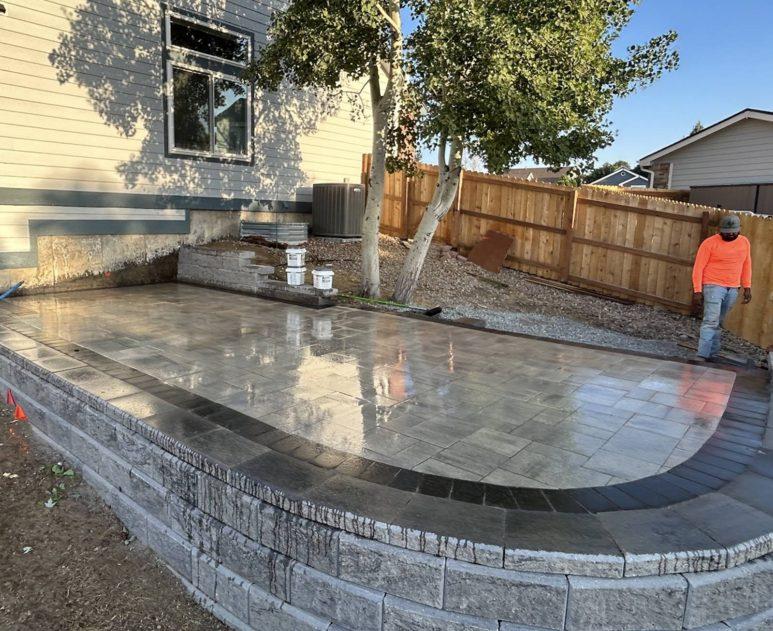
Most retaining wall failures in Brighton come from drainage failure, not from the material failing. When water has no path out, it accumulates behind the wall face and builds hydrostatic pressure with every rain and snowmelt. In Colorado, that water freezes and expands multiple times each winter. The pressure cracks the wall from the inside before the material ever gives out.
A wall with correct drainage has three components working together: gravel backfill behind the face, a perforated pipe at the base and a controlled outlet. When any one of them is missing or undersized, the other two cannot compensate.
01 Gravel Backfill | 02 Perforated Pipe | 03 Controlled Outlet |
12″+ crushed angular stone directly behind the wall face — water path down by gravity | 4-in HDPE at the footing, 1–2% slope toward the outlet — collects and moves water | Discharges below the pipe level — no traps, no backflow, water exits the system |
Gravel Backfill Moves Water Down Instead of Against the Wall
Clean crushed stone placed directly behind the wall face gives water a vertical path down by gravity. Without it, Brighton’s clay soil sits against the wall and traps water in place. Clay is nearly impermeable. Water that enters has nowhere to go except to build up.
Three non-negotiable requirements for the gravel column:
- Minimum 12 inches wide behind the face (Brighton’s clay often demands more)
- Angular aggregate, not rounded stone; angular pieces interlock and hold the channel under load
- Geotextile filter fabric between gravel and native soil; without it, clay fines migrate in and block drainage within a few seasons
A Perforated Pipe at the Base Collects the Water
Water moving down through the gravel column reaches the base of the wall and needs a collection point. A perforated pipe runs along the footing and collects through its perforations as water enters from the gravel above.
Minimum pipe specs:
Spec | Requirement |
Diameter | 4-inch corrugated HDPE or PVC |
Slope | 1 to 2 percent toward the outlet |
Wrapping | Filter fabric sock around full pipe length |
- Diameter: 4-inch corrugated HDPE or PVC
- Slope: 1 to 2 percent toward the outlet
- Wrapping: filter fabric around the full length to block fine material from entering the perforations
Without slope, water sits in the pipe instead of moving. A pipe installed correctly but without slope is one of the most common installation errors in the field. Water that cannot exit the pipe produces the same result as having no pipe at all.
A Controlled Outlet Sends Water Away From the Yard
The outlet is where the system discharges: a storm drain connection, a swale, an infiltration area at a lower grade, or a daylight outlet at the edge of the property. The critical requirement is that the outlet sits lower than the pipe and maintains a positive slope from the wall to the discharge point.
An outlet that terminates at grade level or above creates a trap. Water backs up into the pipe, fills the gravel column and eventually reaches the wall face. That failure pattern looks identical to a system with no drainage at all. The outlet location is determined during the on-site assessment. It depends on the specific property grade and the available discharge options.
Without Drainage, Hydrostatic Pressure Breaks Walls Within a Few Freeze-Thaw Cycles
Water weighs approximately 62 pounds per cubic foot. A column of water 4 feet tall behind a 20-foot wall applies thousands of pounds of lateral force against the face. That force is present continuously every time rainfall or snowmelt feeds the system without an exit path.
The numbers behind the damage:
Factor | Figure | What It Does to the Wall |
Water weight | 62 lbs per cubic foot | Continuous lateral force on the face |
Freeze expansion | ~9% volume increase | Mechanical pressure added with each freeze |
Annual freeze-thaw cycles | 150+ per year in Brighton | Cumulative structural damage over time |
Each cycle adds to the load. The result on a wall without drainage is horizontal cracking, forward lean or a gap at the base. These match the signs of active wall failure that appear within three to five years on walls built without a drainage system.
Brighton’s Clay Soil Raises the Drainage Requirement Above Standard Specs
Front Range soil has high clay content. Clay absorbs water and expands, then dries and contracts. That cycle adds a separate lateral force on top of hydrostatic pressure. In sandy or loamy soil, standard drainage specs handle both. In Brighton’s clay, the drainage system needs to be sized for the actual soil conditions on the property.
That means a gravel column wide enough to handle the clay’s absorption rate, a pipe diameter matched to the expected flow, and outlet capacity confirmed against the site’s drainage load. Contractors who copy specs from other regions and apply them in Brighton produce walls that fail in three to five years despite having drainage components present. The specs have to match the soil.
Brighton’s clay changes the drainage spec: • 150+ freeze-thaw cycles per year — each one adds lateral load on the wall • Clay expands when wet, contracts when dry — lateral pressure on top of hydrostatic • Gravel column, pipe diameter and outlet capacity must match actual site conditions — not specs from other regions |
How Hilltop Includes Drainage in Every Wall
Every wall Hilltop builds includes gravel backfill, a perforated pipe at the footing and a verified outlet. It is not a line item that appears in some quotes and disappears in cheaper ones. It is part of the base scope on every project.
The on-site assessment evaluates soil conditions and determines the drainage specs before the quote is written. When the project requires a permit for a wall over 4 feet, the drainage design is included in the engineered drawings. The result is a wall built to the actual conditions of the property, not a generic spec. Learn more about professional retaining wall installation in Brighton or call (720) 380-0087 to schedule the free on-site assessment.